
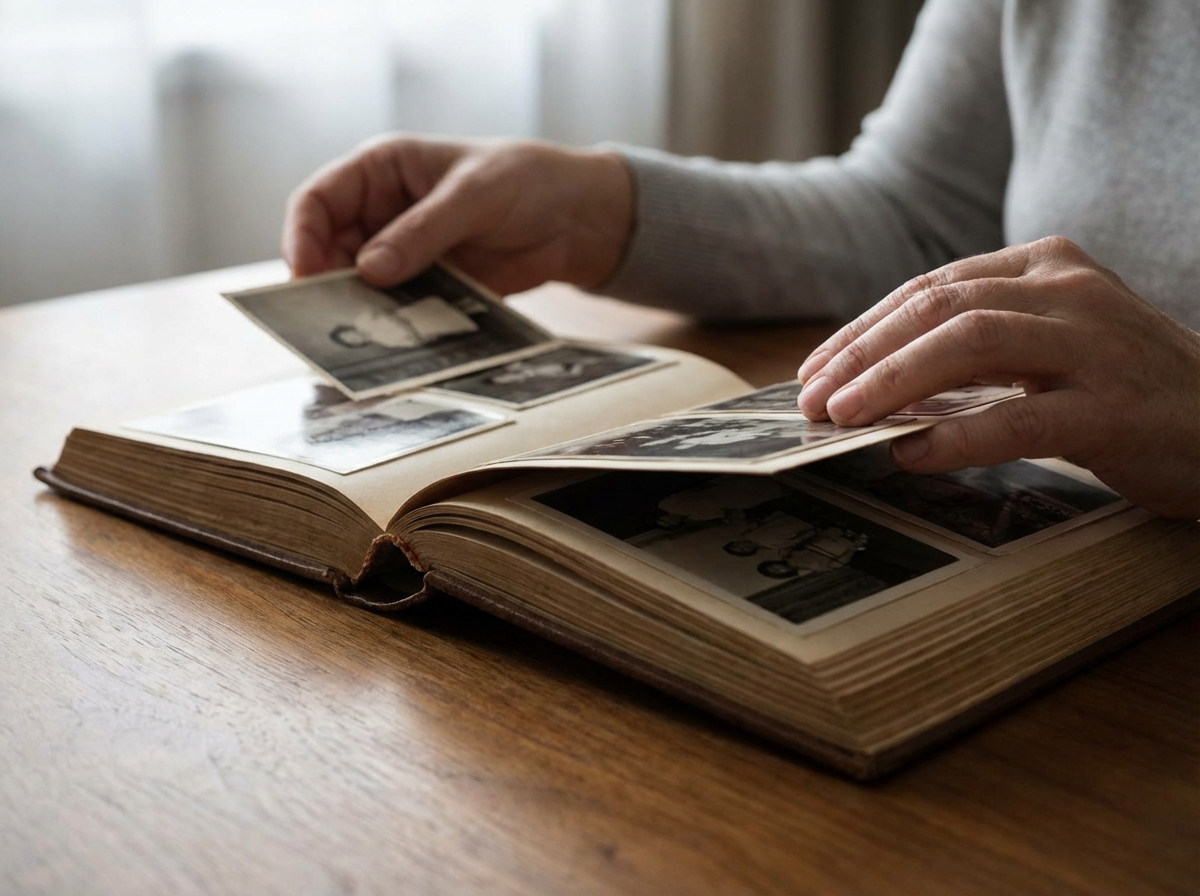
Almost every family has a departure somewhere in its history. From a village to a city, from a city to a new development, from one country to another. A departure like that changes everything that follows, and yet it usually gets summarised in a single sentence. Questions about moving and migration bring up the whole story: the decision, the journey, and the year that followed.
What you'll find here:
- Why a departure is often the hinge of a family history.
- Questions about the decision, the goodbye, the journey and the arrival.
- How to ask about homesickness and regret.
- What to do when leaving was not a choice.
Why this is the hinge
A move or an emigration is rarely just a change of address. There is a weighing-up behind it, often a hard one, and a farewell that at the time was far more final than it would be now. Someone who left for Canada in 1955 knew they would probably not see their mother again.
Everything that came afterwards — the language, the work, the children, going back or not — hangs on that one decision. For many families this is the chapter the rest is arranged around.
Start in 5 minutes
- Pick one departure from the family history.
- Choose 3 questions about the decision or the goodbye.
- Put a photo, a letter or a passport on the table if you have one.
Start here: 3 questions to break the ice
- What did the house you left behind look like?
- What did you bring that you did not actually need?
- Who took you to the boat, the train, or the airport?
How to keep it a conversation
Ask about the decision, not the reason
"Why did you go?" gets you the official version. "Who wanted to go first?" or "When did you know it was really happening?" gets you the story.
Ask about what stayed behind
People talk easily about arriving and with difficulty about leaving. The feeling sits in the second part: a house, a grave, a brother, a job, a language.
Use paper
An old letter, a ship's ticket, a passport, or a box that was never unpacked. On this subject, objects do more than questions.
Keep it from turning into an interview
We build a question plan around the route your family actually travelled, and write follow-up questions based on what was really said. See how it works. See also our guide on interviewing your grandparents.
Questions about the decision
- Whose idea was it to leave?
- How long was it discussed before it was decided?
- Who was against it?
- What did you hope to find?
- What were you most afraid of?
- Was there a moment when you almost changed your mind?
- What did you actually know about the place you were going to?
Questions about the goodbye and the journey
- When did you tell your parents, and what did they say?
- What was the last day like?
- What did you take, and what had to stay?
- How did you travel, and how long did it take?
- What do you remember about being on the way?
- Who was waiting when you arrived?
- What was your first thought when you got there?
Questions about the first year
- Where did you sleep the first night?
- What was the weather like, the food, the language?
- When did you first think: this is going to work?
- And when did you think: this was a mistake?
- How did you find work and somewhere to live?
- Who was the first person who helped you?
- How did you keep in touch with home?
- When did you first go back, and what was that like?
Questions about what it did
- Did you ever feel completely at home there?
- Which language do you think and dream in?
- What did you pass on to your children from where you came from?
- Is there something you never stopped missing?
- Did you ever regret it?
- Would you do it again?
When leaving was not a choice
Fleeing, being expelled, having to go because of war, poverty or family circumstances: that is a different conversation.
Use the word the teller uses
Some people say "we fled", others say "we moved". Take their word rather than laying your own over it.
Ask, but announce it
"Can I also ask how that departure actually went?" leaves room to say no. That makes a yes mean more.
Record it as it is told
The hesitations and the silences belong to it. Our guide on recording family interviews shows how to do that simply.